This article is the second part of the series.
If you haven't read the first part yet, please check it out first!

In this article, we will first explore what happens in the intermediate state between fixed-end reflection and free-end reflection when no transmitted wave is present. Then, we will compare it to the case where transmitted waves exist, as discussed in the first part.
When No Transmitted Wave Is Present
Let's start by understanding the conditions under which the intermediate state between fixed-end reflection and free-end reflection can be observed without any transmitted wave.

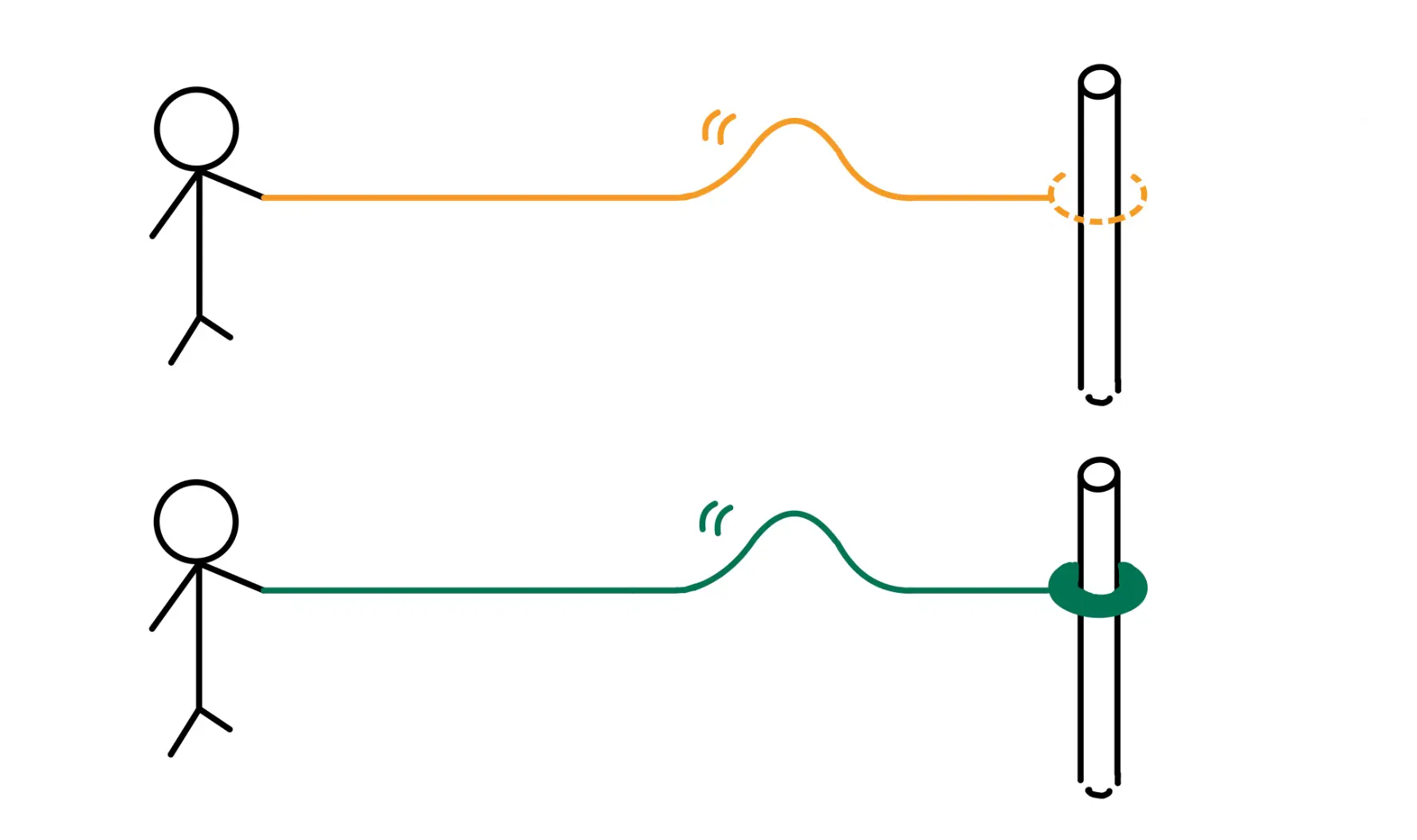
Imagine a scenario like the one shown in the image, where one end of a rope is attached to a ring that slides along a pole, and the other end is moved up and down to generate waves.
If the ring is very light, the end of the rope moves freely, resulting in free-end reflection. On the other hand, if the ring is very heavy, the end of the rope remains stationary, resulting in fixed-end reflection.
As you might have guessed, the intermediate state between fixed-end reflection and free-end reflection can be observed when the ring has an appropriate intermediate mass.
Now, let's confirm this behavior using a graph!
Observe the Graph
Incident Wave | Reflected Wave | Composite Wave | Ring |
|---|---|---|---|
What Happens in the Intermediate State?
First, observe that when the ring's mass is at its maximum, the phase of the reflected wave shifts by, resulting in fixed-end reflection. When the mass is at its minimum, there is no phase shift, resulting in free-end reflection.
(Strictly speaking, the phase shift does not exactly become , but as the ring's mass approaches , the limiting values are .)
Now, let's examine what happens in the intermediate state.
Press the START / STOP button to pause the graph and adjust the ring's mass.
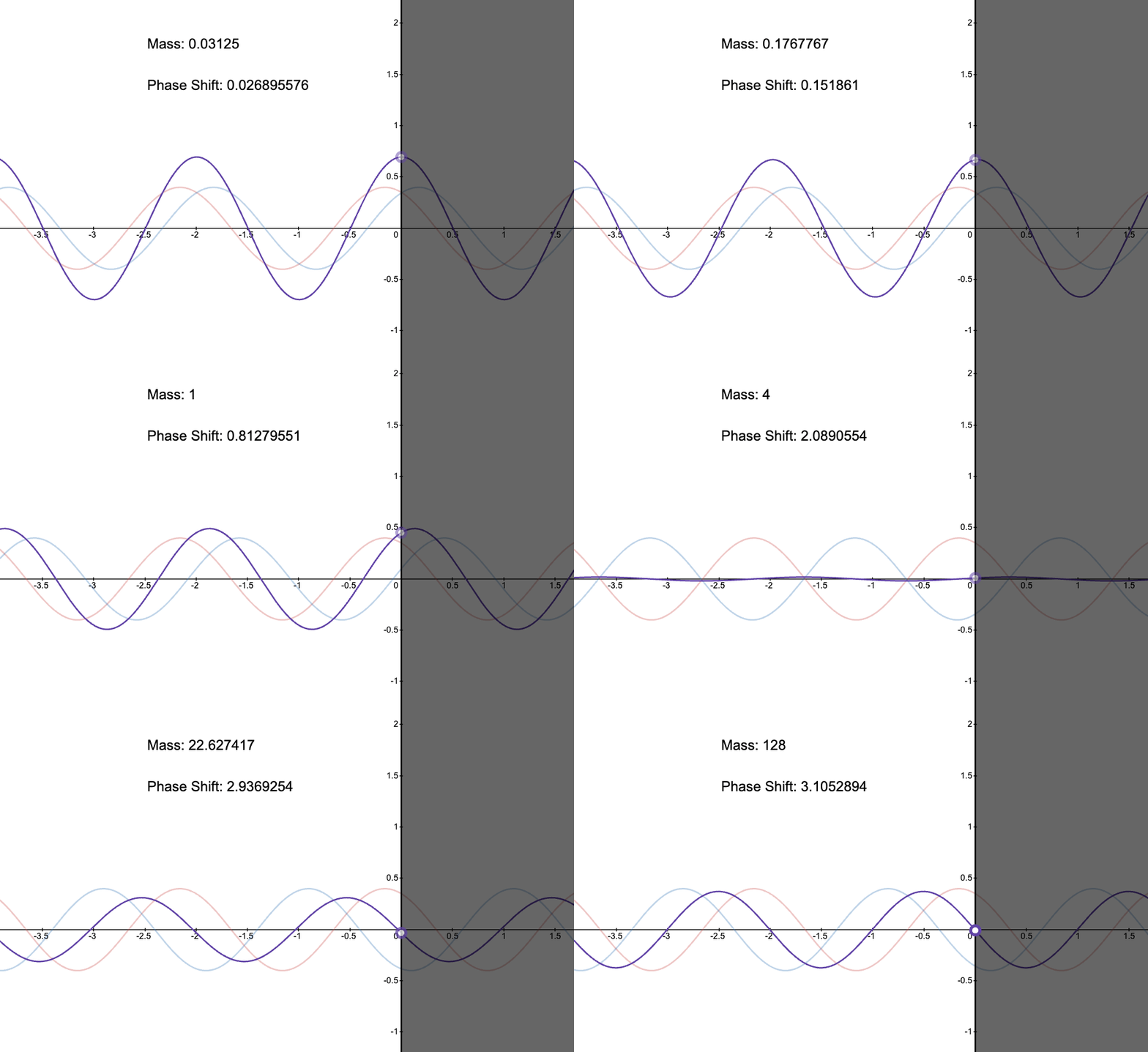
As shown above, as the ring's mass gradually increases, the phase shift of the reflected wave relative to the incident wave changes smoothly from .
Additionally, the composite wave (although the phase at a given time differs) remains a standing wave with the same amplitude and wavelength. You can observe that the positions of nodes and antinodes shift depending on the mass.
Differences Between Cases With and Without Transmitted Waves
As demonstrated, the observed waves differ significantly between cases with and without transmitted waves.
Here's a summary:
Intermediate State Between Fixed-End and Free-End Reflection
【When Transmitted Waves Are Present】
The amplitude of the reflected wave changes, and the phase shift of the reflected wave alternates between two discrete values: 0 and .
【When No Transmitted Wave Is Present】
The amplitude of the reflected wave remains constant, and the phase shifts continuously from 0 to .