Do you know what electromagnetic waves are? Let's explore and observe them through animations!
Animation of Electromagnetic Waves
Electric Field | Magnetic Field |
|---|---|
Electromagnetic waves exist along the yellow axis shown in the animation. The electric and magnetic fields at points along this axis are represented as vectors.
Observe how the electric and magnetic fields propagate as transverse waves on planes that are perpendicular to each other!
Characteristics of Electromagnetic Waves
Here are the main characteristics of electromagnetic waves:
Characteristics of Electromagnetic Waves
- They are transverse waves mediated by electric and magnetic fields.
- The electric and magnetic fields are perpendicular to each other and always coexist.
- They travel at a constant speed, which is the speed of light.
- Their properties vary significantly depending on their wavelength.
Let's dive deeper into each of these characteristics!
Transverse Waves Mediated by Electric and Magnetic Fields
Waves always need a medium to propagate. For example, water waves use water, and sound waves use air.
For electromagnetic waves, the medium is the electric and magnetic fields! For more details on electric and magnetic fields, check out the following article.
Additionally, since the electric and magnetic fields oscillate perpendicular to the direction of wave propagation, electromagnetic waves are transverse waves.
The Electric and Magnetic Fields Are Perpendicular and Coexist
Another key characteristic is that the electric and magnetic fields are perpendicular to each other.
Watch the animation to see how the planes of the electric and magnetic fields are perpendicular to each other!
Moreover, the electric and magnetic fields always coexist. There are no waves made up of only electric fields or only magnetic fields!
Electromagnetic waves are transverse waves where the electric and magnetic fields propagate together, perpendicular to each other.
Speed Matches the Speed of Light
Next, the speed of electromagnetic waves is constant and matches the speed of light.
This is a fascinating and important property. Normally, the speed of an object depends on the observer's speed, but electromagnetic waves always travel at a constant speed, regardless of the observer.
Interestingly, the light we see is a type of electromagnetic wave. Therefore, the speed of light and the speed of electromagnetic waves are the same.
Properties Vary by Wavelength
The properties of electromagnetic waves change significantly depending on their wavelength.
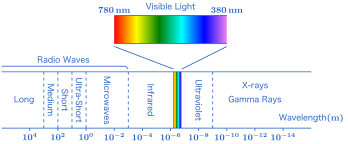
When the wavelength is between and , we can see electromagnetic waves with our eyes. This range is called visible light.
Within visible light, red has the longest wavelength, and violet has the shortest. Electromagnetic waves with wavelengths longer than red are called infrared rays, while those shorter than violet are called ultraviolet rays.
Electromagnetic waves with wavelengths longer than infrared rays are known as radio waves. These include microwaves used in ovens and radio waves used in mobile phones. It's amazing how large their wavelengths can be.
Electromagnetic waves with wavelengths shorter than ultraviolet rays include rays and rays. Due to their very short wavelengths, they can penetrate various materials and are used in ray imaging.
Why Do Electromagnetic Waves Form? (Advanced)
Now, let's explore how electromagnetic waves are generated.
Simple Explanation
Electric and magnetic fields are created by charges and currents, but they also have the ability to induce each other when they change over time.
In other words, when the electric field at a point changes over time, it generates a magnetic field around it. Similarly, when the magnetic field changes over time, it generates an electric field around it.
Doesn't it seem like these two processes could create an infinite loop?
For example, when the electric field at a point changes over time:
Electric field changes → Magnetic field is generated → Magnetic field changes → Electric field is generated → Electric field changes …
This infinite loop is the essence of electromagnetic waves!
Derivation from Maxwell's Equations
Electric and magnetic fields are governed by the Maxwell's equations, which consist of four fundamental equations.
Here, represents the electric field, represents the magnetic field, is the permittivity of free space, and is the permeability of free space. Bold letters represent vectors.
Using Maxwell's equations, we can derive electromagnetic waves. However, since the equations involve complex operators, let's simplify them (though slightly less rigorously):
It's already quite complicated...
To make it manageable, let's assume that the electric field has only an component and the magnetic field has only a component, making all other components . This simplifies the equations to:
This looks solvable! Differentiating the third equation with respect to gives:
Substituting the fourth equation into this gives:
This equation is known as the wave equation, and its solutions represent waves!
For example, a wave traveling along the axis at a speed of can be expressed as:
This satisfies the wave equation!
Thus, the electric field forms a wave traveling at a speed of . Calculating this speed gives:
This matches the speed of light, confirming that this is indeed an electromagnetic wave.
Similarly, differentiating the fourth equation with respect to and substituting the third equation shows that:
This indicates that the magnetic field also forms a wave traveling at a speed of .